
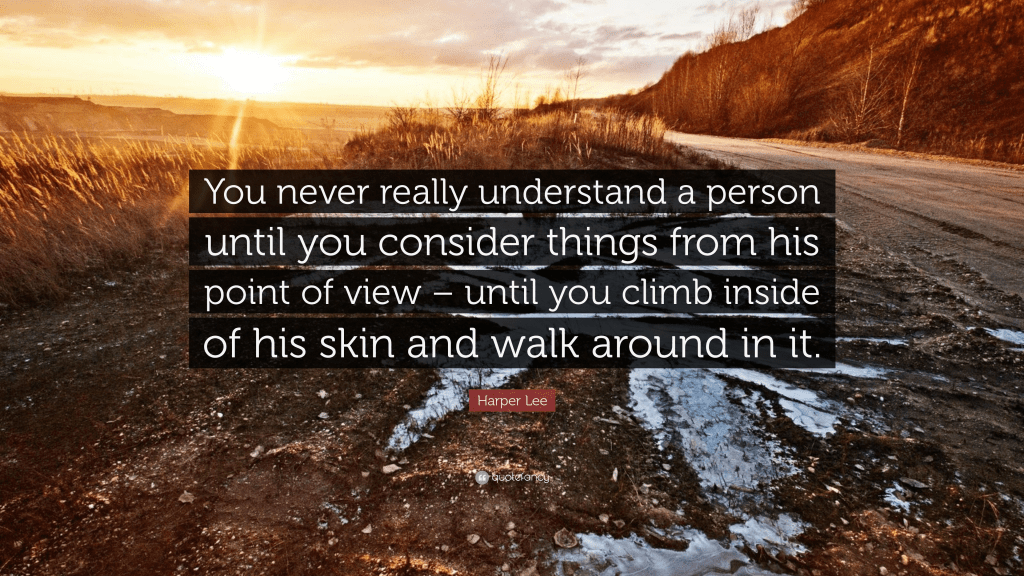
— Harper Lee, To Kill a Mockingbird, 1960, p. 30
Take Action
Take 10 minutes this week to listen to someone’s story—ask them why they’re passionate about something you don’t understand. You may find wonder in the unexpected.
The Story
Stories are powerful. They do more than entertain us—they shape how we see the world.
- Research shows that hearing others’ experiences through their stories activates multiple areas of the brain: emotions, sensory processing, and memory (Zak, 2015).
- Neuroscientists confirm that our brains doesn’t distinguish between stories or real-life experiences, helping us make sense of the world (Cheyfitz & Manne, 2024).
But to truly connect with stories, we have to be open to hearing them.
For most of my life, I wasn’t. Especially when it came to football.
My Fixed Perspective
Being open-minded is critical for growth, learning, and understanding. But many of us form instant opinions that close us off to other perspectives. That was my relationship with football.
In his book How We Think (1910), John Dewey explores what hinders critical thinking. He distinguishes between thinking and mastering the art of thinking—the difference lies in how we use curiosity to learn.
My takeaway: Curiosity makes us smarter.
Yet despite growing up in a family that lives and breathes football, I never allowed curiosity to spark my interest.
- My mom could’ve been a professional sports commentator and even played flag football.
- My grandmother was a die-hard Cleveland Browns fan for 60 years. She once won a recliner from the team, and no one but her was allowed to sit in it!
- My brother became a Steelers fan at age 10 after carefully studying the game and picking Pittsburgh—much to my grandmother’s dismay.
- My uncles and brothers played football, and I spent years worrying about them getting hurt.
- Super Bowl parties were a family tradition. I loved the food but tuned out the game. Everyone knew football wasn’t my thing, and that was fine.
I thought:
Why would anyone risk so much—their body, their spirit—for a sport that rewards so few?
The stats reinforced my negative view:
- 1 million high school players dream of going pro, but only about 300 NFL openings exist each year.
- Even for those who make it, success isn’t guaranteed.
My opinion was also shaped by early reports of concussions in football. I wasn’t open to learning about the sport, its players, or the joy it brought my family.
This is called the backfire effect.
In his 2013 book “You are Now Less Dumb”, David McRaney defines the backfire effect as a psychological phenomenon where we form a belief (usually with limited knowledge) and reject all other perspectives.
That’s the root of bias. It’s something that is running rampant in our society and underpinning much of the serious issues we face.
I finally checked my bias and asked others why they loved the sport. I learned about its history, its challenges, and its impact on people and communities.
Bottom line: I focused on the stories.
What Changed
One day, someone sent me a documentary about a college football coach. His love for his students and the game struck me in a way stats and highlight reels never could.
For the first time, I listened to the stories—of players, their families, and communities. I saw how being part of a team could inspire resilience, foster connection, and how investment into a sport could even drive economic change.
I started watching more documentaries and asked my family and friends why they loved the game. Their stories showed me how football connects people and builds community.
Stories brought football to life for me.
To my surprise, I didn’t hate it. I loved it.
Now, after over 30 years of resistance, I’m a football enthusiast.
Becoming a Newfound Enthusiast
Over the past year and a half, I’ve become a student of the game.
- I’ve fallen in love with college football and rarely miss a game.
- I watch NFL documentaries, like Bye Bye Barry about Barry Sanders and the Detroit Lions.
- I listen to sports commentary shows and read about NFL contracts, stats, and draft eligibility for college players.
The background stories captivate me, like how many Heisman Trophy winners don’t seem to have successful NFL careers.
Now, I wish I had been open to the sport earlier. Here’s why:
↳ The stories of resilience, grit, success, and tragedy hold lessons for life.
↳ Football tactics are great for business and marketing (marketing blitz, anyone?).
↳ It’s an honor to love the things your loved ones love.
What I Learned
- Most people resist learning a new way, clinging to what they already believe.
- Being rigid in our views creates much division.
- There’s even a word for this: hidebound (inflexible).
- A growth mindset—the willingness to explore and learn—is transformative.
I missed so many opportunities to connect with my family and enjoy a fascinating sport because I refused to see its stories. I didn’t care about their stories, why they played the sport, or why they continued to be interested.
In summary, my bias made their opinion not matter.
Since curiosity expands critical thinking – this only hindered my own mental growth.
Don’t make the same mistake.
The Importance of Play
I used to dismiss football as a silly game. Now I see its power to build community, spark joy, and remind us of the love of play.
In a recent documentary about the Madden NFL game, Trip Hawkins, the founder of EA Sports, said it best:
“When we become adults, we’re told that you’re supposed to stop playing. You see plenty of adults going around like zombies because they lost that hunger to just be at play.”
Dr. Stuart Brown, in his book Play: How It Shapes the Brain, Opens the Imagination, and Invigorates the Soul, explains how play invigorates our spirit and fosters creativity and connection.
Football—and all sports—done in their purest form remind us of these truths.
This doesn’t dismiss the sport’s flaws or challenges. Football exists within systems that are flawed. For every positive story you can find about the sport, you can find a negative story about it. But to address those flaws, we must first understand them—and that requires curiosity and open dialogue.
Final Thoughts
Stories matter. Play matters. And opening our minds to new perspectives matters.
This is the power of stories to transform how we see the world.
Even if football isn’t your thing, most of us can agree on this:
If there’s one thing this world needs more of, it’s things that bring us together.
 WONDER
Leave a comment