
Take Action
- Engage intentionally with what you see and hear around you – Question media narratives and educational systems to uncover whose perspectives are being centered and whose are missing.
- Be intentional about language and representation – Whether in the workplace, in academic settings, or in everyday discussions, use intersectionality and critical literacy as tools for meaningful change, not just surface-level concepts.
The Story
Why We Need to Go Deeper
In today’s world, terms like intersectionality and critical literacy are often used in corporate diversity statements and academic discussions. Thus, they are often seen as a non-starter in conversations or as not important to the world beyond those atmospheres.
But I believe there is power in understanding what words really mean in the broader scope of the world. More importantly, understanding words can help us understand how to navigate the complexities of identity, power, and social justice.
Both intersectionality and critical literacy are about recognizing hidden layers—of identity, oppression, and meaning-making. However, as scholars Hopkins (2019) and Luke (2012) argue, these concepts are often diluted, misrepresented, or stripped of their intent.
I recently participated in a critical literacy course. This article unpacks the ideas I learned, exploring their histories, common misconceptions, and how we can apply them to create a more just world.
Intersectionality: More Than a Buzzword
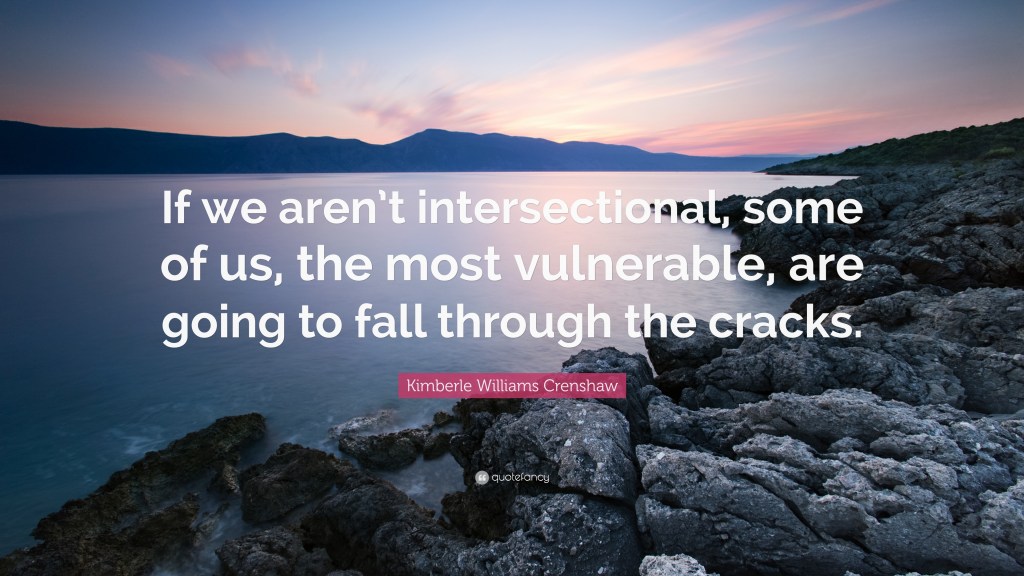
Kimberlé Crenshaw (1991) introduced intersectionality as a framework to explain how multiple forms of discrimination—such as racism and sexism—overlap and shape the lived experiences of marginalized individuals. While this concept was born out of Black feminist thought, Hopkins (2019) highlights how it has been increasingly co-opted, with mainstream scholars erasing its origins.
Hopkins identifies three key aspects of intersectionality:
- Structural intersectionality: The way institutions create layered forms of oppression, such as workplace discrimination.
- Political intersectionality: The conflicts that arise when different aspects of identity force individuals to navigate competing political agendas.
- Representational intersectionality: The absence or distortion of certain identities in media and cultural narratives, leading to harmful stereotypes or complete erasure.
Despite intersectionality’s deep roots in activism and scholarship, many organizations today use it as a catch-all term without addressing its historical and political weight. Hopkins (2019) warns against this depoliticization, arguing that it allows institutions to appear progressive without making meaningful changes to the power structures that sustain inequality.
The Whitewashing of Intersectionality
One of Hopkins’ most striking critiques is how white male scholars frequently cite each other when discussing intersectionality, erasing the Black feminist scholars who developed the concept. This aligns with Bilge’s (2013) argument that intersectionality has been rebranded for mainstream acceptance while stripping away its radical call for justice.
This raises an important question that is broader: What happens when powerful institutions redefine social justice terms to fit their own narratives? The answer is clear: without intentionality, intersectionality loses its transformative potential and becomes just another corporate slogan.
Critical Literacy: Questioning the Narrative
Like intersectionality, critical literacy is a tool for uncovering hidden power dynamics. Allan Luke (2012) defines it as the ability to analyze and challenge dominant ideologies, rather than passively accepting information.
Critical literacy is not just about reading and writing, instead, it’s about asking:
- Who is telling this story?
- Whose voices are being amplified?
- What perspectives are being left out?
Luke (2012) argues that critical literacy helps individuals recognize how language, media, and institutions shape societal norms. He emphasizes that it’s not a monolithic concept, stating that “critical literacies are, by definition, historical works in progress. There is no correct or universal model.”
Why Critical Literacy is Essential
Many people struggle with critical literacy because traditional education systems teach us to absorb knowledge rather than interrogate it. Luke (2012) asserts that critical literacy should focus on:
- Cultural analysis – Understanding how marginalization operates in different social contexts.
- Inclusive perspectives – Ensuring diverse voices and experiences shape the discourse.
- Active engagement – Using critical literacy in daily life, from analyzing media to questioning workplace policies.
In my own experience working in corporate spaces, I’ve spent a lot of time thinking about and ensuring that we are not doing performative gestures. This usually is tied to engaging with the community for real accountability. Critical literacy allows us to push for genuine structural change.
Moving Beyond Theory: Why This Matters
Hopkins (2019) and Luke (2012) both stress that intersectionality and critical literacy are not just academic theories. They are essential frameworks for understanding and reshaping our world.
As a Black woman, I’ve often experienced the erasure and misrepresentation that Hopkins describes. I’ve also seen how language can be used as a tool for both empowerment and oppression. These insights push me to be more intentional in my work, ensuring that I’m not perpetuating the same exclusionary practices that I critique.
Hopkins (2019) suggests three key areas for future research:
- Ethnic residential segregation – Examining how intersectionality plays out in urban planning and segregated neighborhoods.
- Transnational migration – Understanding the multiple identities and connections of migrant communities.
- Embodiment and belonging – Expanding intersectionality beyond identity labels to consider factors like skin color, accent, and clothing.
Luke (2012) echoes this call for deeper engagement, urging us to see critical literacy as an evolving practice rather than a static concept.
Final Thoughts
If we truly want to build a more equitable society, we must go beyond surface-level understandings of intersectionality and critical literacy. These frameworks are not just about diversity, and in fact, by putting it only in that camp we diminish the power of the theory for most people. It is, instead, about understanding power, history, and systemic change.
By understanding the radical roots of intersectionality and actively practicing critical literacy, we can shift the narrative and create space for voices that have long been ignored.
 WONDER
Leave a comment